Saturday, December 12, 2015

30 Days of The Fade Out: The Invisible Man.

In issue #2 of The Fade Out, we're introduced to a disguise of bandages that are part of Shadow of the Valley, the film that the main characters are producing.  The character under the bandages is primarily played by the heartthrob Earl Rath, but we quickly learn that an actor named Morty plays the role for most of the scenes in bandages -- and we learn that Charlie daydreams about disappearing under the disguise, being "made-up like the Invisible Man."


As a them in the noir comic, invisibility may be worth discussing some other time, but before that, we're taking another look at The Invisible Man.  Produced in 1933 and starring Claude Rains, the adaptation of H.G. Welles' novel was famous for its groundbreaking visual effects.  Along with Dracula, Frankenstein, The Wolf Man, and The Mummy, the film established Universal Pictures as the granddaddy of horror films and monster movies.

Turner Classic Movies has a few clips of the movie, and the clip below -- in case the embedding doesn't work, it's titled "He's homicidal!" -- shows the first reveal of the man under the bandages, present but not at all visible.


The effects remain remarkable.  It's no wonder that the movie would still be memorable at the time of The Fade Out, 15 years later.

Labels: ,

30 Days of The Fade Out: On The Road.

At the end of the debut issue of The Fade Out, we learn why Gil Mason was pestering Bob Hope at The Brown Derby:  he was pitching a "road movie" to him.


Knowing that Gil had been blacklisted but was secretly Charlie Parish's ghostwriter, I wonder why he bothered.  Was this just part of a ruse, accounting for why he stuck around Hollywood when he supposedly couldn't get work?  Or did he convince himself that that was the reason, while he was genuinely seeking some sort of significance, with the same drive that would lead to his crusade against the studio apparatus that covered up the murder of Val Sommers?

Either way, it's worthwhile to take a closer look at what Gil was actually proposing.

He mentioned a story of Bob Hope barely escaping the Germans in Africa, an event that USA Today described as "stranger-than-fiction" in an August, 2014, feature on The Fade Out.  While I haven't been able to find more information about that particular story, I've found that Hope did survive an intense bombing raid, both he and his troupe, dubbed the Hope Gypsies.
The Gypsies did their first USO combat zone shows that summer in North Africa, Italy, and Sicily. Palermo offered them both their largest audience—19,000—and a narrow escape with their lives when 100 Nazi Junker JU-88s with a fighter escort dive-bombed the docks, destroying the area around the troupe’s hotel a few blocks away. Hope said that returning safely to the States that fall “was something of a letdown. Hollywood was tinsel and make-believe and happy endings. Where we had been was mud and reality and horror.”
(The entire article linked above, from the October 2007 issue of the magazine America in WWII, is definitely worth reading, with mentions of Clark Gable and Jimmy Stewart, John Steinbeck and General George Patton.)

Inspired by the comedian's narrow escape, Gil pitched an addition to the "road movies" series starring Bob Hope and Bing Crosby.  Between 1940 and 1947, the pair had released the first five entries in what would be a seven-film series.  Highlighting Bing and Bob's musical and comedic talents, the films were quite popular in their time, so it's not unreasonable that a seemingly out-of-work actor would try his hand at pitching a "road movie."

The movie series continues to influence pop culture, most recently with Family Guy's pastiches featuring Brian and Stewie:  if a movie musical was prominent, Seth MacFarlane will riff on it, sooner or later.  One of the episodes comes very close to Gil's proposal, being titled "Road to Germany," just as They Might Be Giants had a song called "Road Movie to Berlin" on their 1990 album Flood.

And the films remain quite entertaining to this day.  As a sample, here's the title song to 1942's Road to Morocco.


We can't help but wonder, was that camel on a treadmill?

Labels: ,

Thursday, December 10, 2015

30 Days of The Fade Out: Year's End and the Story's End!

In the midst of our lengthy look at The Fade Out, we see a couple news items worth reporting.

First, as we approach the end of the year, we're sure to see Brubaker and Phillips' The Fade Out on more than one best-of list.  The first we have found is from The A.V. Club, published today.  Oliver Sava zeroes in on the duo's expertise in straight-up crime comics.
While Brubaker and Phillips can do outstanding things with a good gimmick (recent examples: crime noir Archie in Criminal: The Last Of The Innocents, crime noir Lovercraft [sic] in Fatale), they prove to be especially brilliant when they tackle the genre head-on without a high concept.
Sava also notices that the focused setting and limited scope make the title "a particularly immersive series" with a tightly plotted story.  We agree, and the brilliance of this limited series should be a consolation to those of us who will miss the book -- that, and the promise of another project on its way.

The end continues to draw near for The Fade Out, as earlier this morning, Sean Phillips sent out a simple tweet announcing that he's completed his work on the project.

He subsequently relayed to us here that we might want to extend our 30-day review, as the release date for issue #12 has been pushed back to January 6th, and I now see that ComicList confirms the date in the extended forecast it published at the beginning of the week.

(UPDATE, 12/11:  On Twitter, Sean explains that the issue has been delayed because it contains 34 pages of story -- we think the book deserves an extra-long finale -- and Ed Brubaker explains that work still remains, including the illustration for the bonus essay and Bettie Breitweiser's coloring.)

Personally, I would have liked to end the year with The Fade Out's finale, putting a cap on an incredible year for Brubaker and Phillips that began with the spectacular Criminal Special Edition and the new editions of that series' trade paperbacks.    But I'm sure it'll be worth the wait.

And will we write even more than we've planned until then, going 37 days or more?  Even with the holidays, we'll do our best.

In the meantime, we greatly appreciate Ed Brubaker's kind words for our post yesterday.
A work as complex and satisfying as The Fade Out begs for a closer look, and we're happy to serve.

Labels: ,

Wednesday, December 09, 2015

30 Days of The Fade Out: Vice, Trysts: Epic Torture.

The title above is an anagram of Victory Street Pictures, the focal point of the sordid world of The Fade Out.

We're reminded that the word "hypocrisy" has its origins in the Greek word hypokrisis -- play-acting, where the dramas in Ancient Greece would often have their actors wear masks, severing the outward appearance from the inward reality.  Actors lie for a living, which is a big reason the profession has often been considered disreputable.

To the intrinsic allure of acting, the newly developed mass media added the promise of large box office receipts, unprecedented fame, and the power that came with both:  it's no wonder a person would live a compromised existence to make it big.

Secrets and lies are a big part of The Fade Out, as the comic's opening scene suggests it's something almost in the atmosphere of Hollywood's Golden Age.


Rereading the first eleven issues last night, we noticed how -- even before the murder that instigates the story -- almost every named character around Victory Street Pictures is living one kind of lie or another.  The story reveals almost all of these characters twice, first as the image and then as the reality.
Co-founder Victor Thursby (formerly Noah Feldberg) joined a hedonistic cult in 1928, and decades later he has a system to take advantage of the studio's actresses; after someone intimates that he knows about the cover-up of Valeria Sommers' murder, it's clear that he has stacks of documents that he needs destroyed, which were evidently "Old Man Kamp's sick stash" of photographs. (Issue #3, 9, 10)
(UPDATE, 12/11:  We had forgotten to add a detail from issue #2, that Thursby came to Hollywood under what was presumably his given name; he likely changed his name because of the prevalence of anti-Semitism.) 
Thursby's partner Al Kamp is evidently as much a predator as Thursby, but -- to paraphrase a character from the Criminal arc "Lawless" -- his tastes seem to run weirder and darker:  he introduced Thursby to that cult around the same time that he abused the child actors who worked for him, and years later Val and Charlie stumble upon him in the woods, in a compromising position with a woman, a camera, and some rope. (3, 5, 9)
Supposed producer Drake Miller uses his knowledge of the abuse at Victory Street both to insinuate himself into the studio and to threaten its personnel, all to advance the agenda of his real employers in the government. (10)
Screenwriter Charlie Parish is using one secret to hide another, taking dictation from his blacklisted friend to hide his crippling postwar writer's block. (2)
Fellow writer Gil Mason did evidently have Communist sympathies, but -- probably in the face of an unavoidable blacklisting -- he concocted the scheme that Charlie would rat him out to the Feds, to throw off any suspicion that they were working together for mutual benefit. (2)
Lead actor and heartthrob Earl Rath has his own secret hobby involving photography and the women he encounters at his infamously debauched parties. (4)
Up-and-coming heartthrob Tyler Graves lives a lifestyle that would scandalize the public of the 1940s and turn off his female admirers. (5)
Starlet Valeria Sommers (formerly Jenny Summers) is hiding a dark secret about her life as a child actor; Charlie theorizes that she is being blackmailed as the victim of abuse rather than its perpetrator. (10, 11)
Up-and-coming starlet Maya Silver seems to be hiding her family background, or at least the fact that she had married a Mexican; either way, it's a past that Charlie was surprised to learn. (8)
Maya's agent Tom Greavey had apparently lied to her before, in his previous assurances that she was about to hit her big break. (3)
Publicity girl Dottie (Dorothy) Quinn was being blackmailed by Drake Miller:  the implication is subtle but unmistakable, that Dottie was having an adulterous affair, but not with a married man. (10)
And even Phil Brodsky, the head of studio security, wasn't above lying to induce an actress to exchange sexual favors for influence that he didn't really have. (3)
The only person around Victory Street who isn't revealed to be a hypocrite is the director Franz Schmitt:  described as a German expatriate, perhaps he has had to adjust his political loyalties through a world war and its aftermath, but that's only conjecture.

Have we seen the breadth of the lies at Victory Street?  Certainly not, as it hasn't yet been revealed who murdered Val Sommers and why -- and who was the "kind man" who protected her and helped her move on from her life as Jenny? (we have our theory) -- but there's one other secret that might be revealed:  we know that Charlie came back from World War II a broken man, but we wonder if there's more to the story.

We're reminded of the last couple lines from the three-page trailer for The Fade Out.


In explaining Gil and Charlie's ghostwriting arrangement in issue #2, the narrator tells us that Gil "knew Charlie's ugly secret... at least part of it."

Labels: ,

30 Days of The Fade Out: Action in Every Issue.

Having just reread the first eleven issues of The Fade Out in one go, I'm amazed by the details that I've missed, particularly the subtle images that are paid off months later for those of us who have read the individual issues.  That hazy memory of debauchery in the first issue isn't just setting the scene:  the image is reused in issue #8, when the moment suddenly becomes important.  And that beach house in issue #7, which we barely see, we'll see again in a flashback.

What's also impressive is that Brubaker and Phillips avoid the pitfall of making issues with nothing but dialogue, exposition, and only verbal threats of violence -- what I'm guessing is a particularly tough challenge for naturalistic comics, as opposed to the super-powered mayhem of Sleeper and Incognito and the supernatural horror of Fatale.

In the second Criminal arc, "Lawless," Brubaker challenged himself to include a heist in every issue, and the story is told so effortlessly that you don't notice the gimmick:  every "job" is a natural consequence of the narrative.

Here, in The Fade Out, there's at least one violent or otherwise criminal act in every issue, and it's worthwhile to enumerate them without going into too much detail.
  1. A woman is found murdered, and her murder is covered up as a suicide.
  2. Two men have a fistfight in a cemetery -- and not the last fight between them.
  3. In addition to a lot of hedonism and sexual deviancy, a man is beaten and "taken for a ride," with his fate unknown except that he won't be killed.
  4. A man is evidently murdered, and his house is destroyed by arson.
  5. A man is beaten to a bloody pulp, and enraged, his gay lover recklessly drives his car off the road, at high speed.
  6. A quieter issue, a man begins to threaten other, very powerful men with blackmail.
  7. Two men have a fistfight in a bar, with one suffering blackouts afterwards.
  8. Two people search an opium den for the man beaten up in issue #3, now strung out because his life has been ruined.
  9. After one of them retrieves his service pistol from the war, the two men from the fight in issue #2 have their second fistfight in an office; long ago, the two had been tied up in the back room of a mob-owned bar, and in the present day, one of them conducts the very dangerous work of a private eye.
  10. After getting repeatedly punched for the fourth time in this series, a central character breaks into and enters an unlocked office, looking for answers.
  11. Another man has been found murdered, and a shootout ensues, injuring one man -- evidently fatally.
In the sordid world of this noir story, the threat of violence isn't just real, it's frequently erupting, and it makes for compelling reading.

Labels: ,

Monday, December 07, 2015

30 Days of The Fade Out: Fake Movies with Occasionally Real Actors.

Say you're publishing a monthly comic:  what do you with the back cover?

You can use the space to create a wraparound cover, as we saw with Criminal and Incognito, you can preview the next issue's cover art, as we see with the comic Chew; you can have the comic's logo on a plain page, as with the comic Black Science; you can run an ad, as we see on the back of Ed Brubaker's Velvet.

You can have blurbs praising your work, as with the Criminal Special Edition, or you can set the mood by featuring a single striking image of interior artwork, as with Fatale.  Or, you can create new artwork to flesh out the fictionalized world of your story, and that's precisely what Sean Phillips did with The Fade Out.


What we see are black-and-white promotional stills for movies from the 40's and earlier, featuring the comic's main characters as the cast and produced by the comic's fictional studios.  Production years are also added as the series progresses.

Sean Phillips featured a couple of the images in his blog, The Neon Nightmare and Way Out West.  While I haven't been able to find real-world photos that match the exact style of these cards, they do look authentic to the era, and they cover a wide range of movies produced in Hollywood's Golden Age, from adventure movies and westerns, to comedies including kids' shorts that resemble Our Gang, to horror and noir.


Bonus material from a comic's fictional universe is nothing new, going at least as far back as the excerpts and editorials in the back pages of each issue of Watchmen.  The most dramatic example may be Brubaker and Phillips' own magazine-sized variant to the Criminal Special Edition, where the entire package -- and quite a few pages in the story itself -- was a pastiche of the sword-and-sorcery comics of the 1970s.

The most subtle example might also be found in the works of Brubaker and Phillips.  In the bonus essays for the pulp-noir mashup Incognito, Jess Nevins provided an overview of some classic pulp characters.  The essay in the last issue for the first story arc focused on the "zeppelin pulps" -- the essay's expanded version that we mentioned in 2009 is still available online -- and Brubaker eventually admitted that the essay wasn't entirely historical.  Rather than flesh out the characters of Incognito in their own universe, the essay pretended to expand on their presence in our universe, giving readers the impression that the comic's characters were created during pulp's heyday and were simply being repurposed by Ed and Sean.

In one instance, The Fade Out's back-cover movie card included a real actor and a real studio, deepening the reader's impression that the story takes place in our world with its sordid film history.

Here we think it's worthwhile to list the cards' descriptions, with the two real-world references in bold.
  1. VICTORY STREET PICTURES presents: THE NEON NIGHTMARE starring Earl Rath
  2. VICTORY STREET PICTURES presents: VALERIA SOMMERS in THE DARKEST HOURS OF THE NIGHT
  3. VICTORY STREET PICTURES presents TYLER GRAVES in WAY OUT WEST
  4. VALERIA SOMMERS as "LANA" in: "HONEYMOON IN BLUE" VICTORY STREET PICTURES © 1945
  5. KAMP PRODUCTIONS presents SKINNY CARMICHAEL in SKINNY DIPPIN' © 1919
  6. FLAPJACK and TEENSIE in "THE KRAZY KIDS GO FOR A RIDE!" © 1926 Kamp Productions
  7. RAY MILLAND and JESSICA TOWNE in "AT THE END" © 1941 RKO
  8. Earl Rath in "THE DEADLY SANDS" © 1943 Victory Street Pictures
  9. COMING SOON from VICTORY STREET PICTURES - Earl Rath in "Shadow of the Valley"
  10. BARBARA MOONEY in THE BIG PARADE © 1948 Victory Street Pictures
  11. FLAPJACK in "THE KRAZY KIDS CHRISTMAS CAROL" © 1928 Kamp Productions
As issue #7 details, Charlie Parish wrote the screenplay for At The End, which might have won an Oscar if it didn't go up against Citizen Kane.  The latter was snubbed for the Best Picture award in 1942, in the ceremony honoring movies released the previous year: infamously losing to How Green Was My Valley, Kane did win the Oscar for Best Original Screenplay.

UPDATE, 12/9:  The obvious was pointed out to me, that the movie card for issue #11 includes a young Valeria Sommers (aka Jenny Summers) in the background:  the blonde girl didn't completely resemble the starlet from the 1940's, but she's clearly the same girl as the one in the phot of Jenny Summers in issue #10.

I'm overdue for another careful reading of the entire series, but I believe that the movie card for issue #9 is the first -- and perhaps the only -- mention of the title of the movie being made at the time of Valeria's murder, the ominous and appropriately titled Shadow of the Valley.

UPDATE, 12/9:  It is: at least through the first eleven issues, the title of the movie everyone is working on isn't mentioned, except on this one back cover.

UPDATE, 2/17:  Corrected the spelling for Valeria Sommers, for the card on issue #4.

Labels: ,

Sunday, December 06, 2015

30 Days of The Fade Out: Setting the Scene in Twelve Striking Covers.

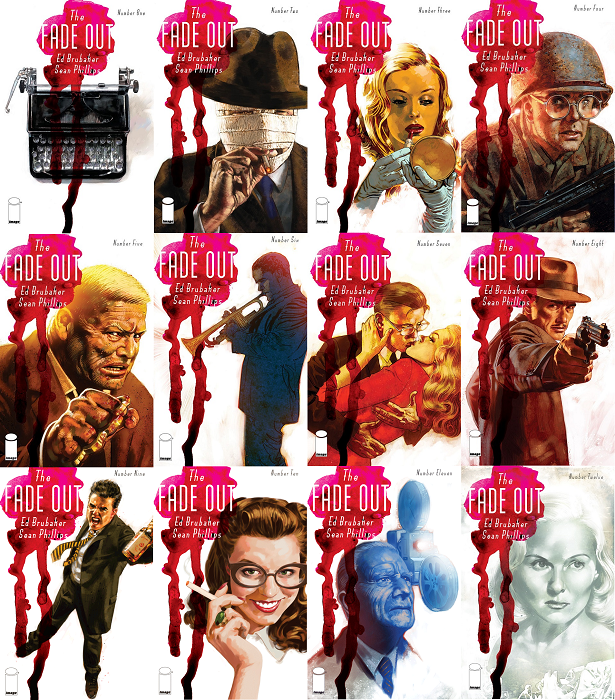
We remain impressed with Sean Phillips' cover art where, with each new story, he presents variations on a theme and a change in his approach to art design.  As we did with the monthly and collected covers for Fatale and the new editions of Criminal, we've collected the artwork for the standard issues into a single collage.


Readers can download a much larger, 6.61-MB version of this image on Google Drive.

Continuing our previous discussion of possible suspects, we see that each of the eight most prominent characters appear on at least one cover.  That accounts for eight of the standard covers, but what about the other four?

Charlie and Maya appeared separately toward the beginning of the series, and they appear together on the cover for issue #7, locked in an embrace.  Flapjack Jones appears on the cover for issue #6, playing the trumpet; he's one of two big-band musicians featured in the book, though his musical ability isn't included in his character description.

Issue #2 features the bandaged man from the film that Victory Pictures is producing -- "Shadow of the Valley" -- and Earl Rath plays the character, but in most of the scenes where the character is "made-up like the Invisible Man," the part is played by an actor named Morty.  In that issue, we learn that Charlie daydreams about disappearing under the disguise, and he lives out that fantasy -- poorly -- in issue #8.

And, of course, The Fade Out #1 is adorned with an image of a vintage manual typewriter.  We strongly doubt that an inanimate object is the mastermind behind the story's central mystery.

Beyond what we can infer about the story's whodunit from who made the cover, we are struck by how much is conveyed with so little visual information.

Here, we see the story's major characters with a handful of props and the story's title on that spill of blood or red ink:  there's no background, no unrealistic coloring, and no text description, and none of that is really needed.

Jazz music, the movies, and the war; guns and fedoras, cigarettes and a bottle of booze; glamour and the threat of violence; romance and a sense of yearning:  these few isolated images effortlessly establish the setting and set the mood.

And while the cover layout isn't as flashy as some other titles, and the content isn't as sensationalistic, The Fade Out stands out on the comic shop's walls.  Even those who don't already know Brubaker and Phillips can tell, here they'll find the kind of story you won't get in any other book.

Labels: ,

Newer Posts Older Posts