Monday, July 07, 2014

30 Days of Fatale: Unhealthy Obsessions.

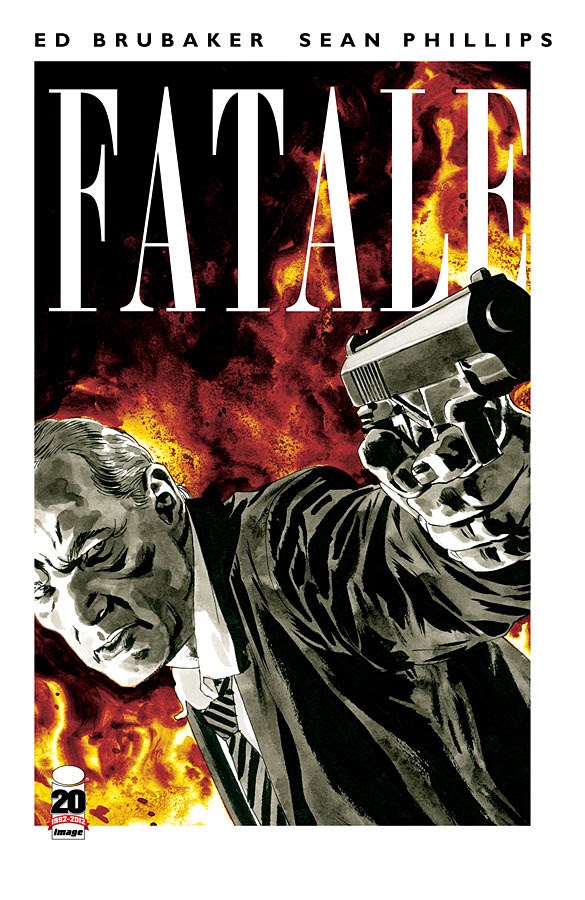
While almost every scene in Fatale #2 involved betrayal, Fatale #6 appears to focus on unhealthy obsessions -- I mean, besides spending an entire month writing daily essays about a single comic book series.  The issue kicks off the second arc, "The Devil's Business," and it was released on June 27th, along with a five-page preview and the trade paperback collection of the first arc, "Book One: Death Chases Me."


The most obvious obsessions are about Josephine, perhaps not entirely because of her curse.  The issue spends just two-thirds of a page on Alan Marshal; as Jo recounts in her journal, he was a recovering alcoholic whom Jo used to help Hank in his writing career, and he ended up losing his self-control, his job, and ultimately his life.

The obsession that the series spends the most time examining is that of Nicolas Lash.  At this point in the present-day narrative, he had spent a year searching for Josephine after their one nearly deadly encounter.  We don't learn much about his life outside of this obsession -- his career, his friends, or his interests -- and I believe the only flashback on his life will be in issue #8, where we see his nearly forgotten first encounter with Jo when he was about six years old.

The clearest hint at the life he's abandoning is on the first page of this issue:  the poignant scene of voicemail messages heard but never answered.


Josephine has her own obsession, at least at this point in her life, in the flashback set in Los Angeles in the summer of 1978:  she is trying to run from life itself.  Where she had earlier found a temporary kind of safety as Walt Booker's kept woman, she is now seeking safety isolating herself from all men, becoming "the wrong Hollywood cliche" of a recluse.

And I notice that not every unhealthy obsession in this issue involves Jo's supernatural powers.  The story in the 1970's begins with the struggling actor Miles trying to score some cocaine so he can get into a party of A-listers, where he would "stumble" on his one good movie being played on the late show and thereby revive his languishing career.

His plan was pathetic, and his night would have probably ended badly even if it hadn't taken a turn for the bloody and bizarre.  

Fatale doesn't lecture, but all four cases of obsession's bitter fruit warns the reader about where his appetites and ambitions might lead.

Labels: ,

Sunday, July 06, 2014

30 Days of Fatale: 13 Reasons to Buy the Single Issues.

Just more than half of Fatale's 24 issues will have an essay in the back as an extra feature not found in the trade paperback collections.  

If it hasn't felt as if there were that many essays in the latest series, the essays were front-loaded a bit:  seven of the first eight issues had an essay, while only three of the last eight will include an essay.  In issue #5, the comic spilled far past the standard 24 pages to 27, leaving only one interior page for Ed Brubaker's note to his readers; issues #8 and #23 had reader letters, and issue #16 printed the four-page "trailer" for Velvet, Brubaker's new collaboration with Steve Epting.  For other issues, Brubaker relayed that they didn't want to cause further delays by including the extra essay.

The final Fatale is an extra-length issue at 48 pages, and Brubaker has told A Criminal Blog that the issue will include 34 pages of story, which will leave plenty of room for extras.  One of those extras will be an essay by Jess Nevins, and Sean Phillips has posted two images of original artwork that will accompany the essay.


From November, 2011, to June, 2012, Sean Phillips contributed to a group blog called What Not, featuring assorted artwork from "a varied group of artists," including Cliff Chiang, Mark Chiarello, and Phil Noto.  It's an interesting blog to browse, and for one entry on the theme of authors, Phillips posted the gorgeous art for the first arc's essays, which are also worth another look.

Together the thirteen essays comprise a very strong reason to collect the single issues of Fatale, and we're happy to list them here for readers' reference and (we hope) for their eventual inclusion in a page on Wikipedia.

  1. H.P. Lovecraft and the Horror of the Unseen, by Jess Nevins, in issue #1
  2. Edgar Allan Poe: Reality as a Grotesque Deception, by Jess Nevins, in  issue #2
  3. Dan J. Marlowe: Echoes of a Hard-Boiled Past, by Charles Kelly, in issue #3
  4. The Real Philip Marlowe, by Stephen Blackmoore, in issue #4
  5. Horror and Mystery Fiction Part 1: Ontranto to de Grandin, by Jess Nevins, in issue #6
  6. Horror and Mystery Fiction, Part 2: The Weird Menace Pulps, by Jess Nevins, in issue #7
  7. The Devil Inside Me: Devil Pulp, by Jess Nevins, in issue #10
  8. The Lonely Doll, by Megan Abbott, in issue #12
  9. Strange Stories, by Jack Pendarvis, in issue #13
  10. Aleister Crowley, by Jess Nevins, in issue #15
  11. Cthulu Lives! On the Afterlife of H.P. Lovecraft, by Jess Nevins, in issue #18
  12. Cults in Fiction, by Jess Nevins, in issue #21
  13. Leaping the Fence: Fallen Heroes and Redeemed Villains, by Jess Nevins, in issue #24 

They make great reading, at they put Brubaker and Phillips' horror noir in its larger literary context.

Labels: , ,

Saturday, July 05, 2014

30 Days of Fatale: Fathers and Sons.

The first arc, "Death Chases Me," reaches its violent and disturbing conclusion with Fatale #5, published on May 9th, 2012, after the release of a five-page preview. 

I believe this issue makes the first allusion to the Great San Francisco Earthquake of May 18th, 1906.  In the real world, the earthquake and the resulting fire probably resulted in 2,000 to 3,000 deaths.  In the world of Fatale, the cataclysm was the result of a key event that's referenced again in issue #13 and issue #22:  the sacrifice of Jo's predecessor Bonnie and the rebirth of a human named Sommerset into the inhuman Bishop.

The Bishop returns to the subterranean scene of that crime, evidently expecting to sacrifice Hank and Jo after Booker has brought the immortal woman to him.  Things don't go as planned, and the Bishop is permanently blinded, seemingly killed, and reborn in a new host body.

Brubaker and Phillips don't just obscure the worst brutality, as we discussed last time; they are often subtle in conveying key plot points.  I particularly remember a cliffhanger ending in "Coward," where I wondered if Leo had taken the stash with him.  He had, but that fact was never mentioned outright in narration or dialogue, only shown as without fanfare as Leo left his hideout to try to make things right with the crooked cop that set him up.

Here, I think we're left to wonder, was it never Booker's real plan to betray Jo into the Bishop's clutches?  My guess is that Walt Booker really intended to sacrifice Jo for a cure to his cancer, but he had a change of heart when she confronted him in the police station and he broke down in grief, near the midpoint of issue #4.

And where did the child come from, which the Bishop possessed in the grotesque ritual of reincarnation?  We can deduce the infant's origins from a single line from one of the cultists.

"It's been over a week since he cut it out of the woman."

Bishop was reborn in the infant son of Hank Raines:  the police had mistakenly concluded that the child died with his mother.

In the next arc, "The Devil's Business," we find out that, in the 70's, Jo had had a son, and in the penultimate issue, #23, we discover along with Nicolas that she had this son with Hank.

In much of Brubaker and Phillips' work, especially Criminal and Scene of the Crime, families are crucial and sins reverberate through the generations.  In Fatale, there is a long line of women like Jo, and their powers torment generations of men.

For Dominic "Hank" Raines, the generational drama hits much closer to home.

Unbeknownst to Hank, his infant son through his wife Sylvia becomes the new host for the Bishop.  Tension over his son with Jo ends their relationship, and Willie's violent, oedipal reaction to his mother's powers and his subsequent suicide is the great tragedy of her life.  And his godson Nicolas -- the son of his friend, the now-mad photographer Johnny Lash -- plays a central role in the story's conclusion.

This epic tale matches Sleeper in length and, in its scope, it surpasses all of Brubaker and Phillips' previous work.  It's a Lovecraftian horror-noir, but it has revealed itself to be much more than that.

For Jo, Hank, Walt, Nicolas, and quite a few other characters, the story is a deeply moving tragedy, made more moving with Sean Phillips' moody art.


Labels: ,

Friday, July 04, 2014

30 Days of Fatale: The Unseen Horrors

Fatale #4 was released on April 4th, 2012, alongside the final second printing for the series -- for issue #3 -- and on the heels of a five-page preview.  The body count continued to mount as the Bishop drew closer to finding Jo, but Brubaker and Phillips showed remarkable restraint in hiding the worst of his monstrous acts.

Modern comic books have a reputation for sensationalism and glorifying brutal violence, albeit with the tongue often planted firmly in cheek, but Brubaker and Phillips' work stands apart.  Criminal's first arc, "Coward," was as brutal as any Sin City story, but I believe it was more effective in its humanizing the victims rather than emphasizing the viscera.

The writer's rule is "show, don't tell," but that rule doesn't apply in horror -- or in classics like Jaws, when the deadly great white was obscured as long as possible.  The imagination can often do a much better job at feeding one's fear, and it's not just Sean Phillips' art that benefits from things being so often hidden in the shadows.


Over the course of issues #2, #3, and #4, the Bishop murdered Hank's wife Sylvia, and Hank was arrested and questioned about her death and the grotesque manner in which she was killed.  In just those three issues, we saw plenty of violence -- one man's throat and half of another man's head eaten away, Jo commanding a cultist to shoot himself in the head, a gruesome truck of corpses that only young Walt could see, and Walt's partner Lannie being stabbed repeatedly -- but we saw neither the Bishop's murder of Sylvia nor the crime scene afterwards.


The murder was merely described, and even then we don't read the description as much as see people's reactions:  a newspaper account made Dominic run in terror a half-century later, and the crime-scene photos and the police account made Hank scream uncontrollably.


For all that we see in this arc, it's what we don't see that's most haunting, an unseen horror that is more effective because we only approach its obscene reality in the most indirect way.

Labels: ,

Thursday, July 03, 2014

30 Days of Fatale: "The Losing Side of Eternity"

Fatale #3 reached stores on March 7th, 2012, following a five-page preview.  The issue ended up with a second printing, with a black-and-white variation of the first printing's cover of the crooked cop, Walt Booker.


With the next issue, initial orders finally caught up with demand, so this would be the last issue with multiple covers until we saw a couple rare variants for Fatale #15, kicking off the fourth arc, "Pray for Rain."

The issue begins with an interlude, returning us to Nicolas' story.  In the month after Dominic's funeral and Nicolas' fateful first encounter with Jo, he became obsessed with his only connection to the mysterious woman -- "The Losing Side of Eternity." Nicolas had just found this early unpublished manuscript written by his godfather, and Jo had recovered it for him after the explosion that left him crippled.


Fessing up in the author's page at the end of the issue, Ed Brubaker hoped that readers would draw the wrong inferences about the manuscript, assuming that it was an autobiographical account of the events in 1956.  Its contents were much stranger than that, and it would set a theme that would recur throughout the series, a motif of important but mysterious books and other works of art.
  • The first arc, "Death Chases Me" (issues 1-5), kicks off with the discovery of "The Losing Side of Eternity," which would continue to play a role in the series. The closing issue reveals that Jo's "heirloom" was a fragment of a parchment of "an unspoken language written on the skin of some ancient wyrm."
  • "The Devil's Business" (issues 6-10) centers on a film reel of an evidently grotesque ritual, which Miles impulsively took from the Bishop's "Method Church," and an ancient book that Jo took with Miles help.
  • In "The Case of Alfred Ravenscroft" (issue 11), Jo sought out the Lovecraftian writer for the origin of his strange pulp story, originally titled "To The Unseen Eyes."
  • In "A Lovely Sort of Death" (issue 12), Jo's medieval predecessor Mathilda found refuge with a hermit named Ganix, who told her fairy tales, including one about an owl with "the thread of the world in its claw."  After she disappeared, a mysterious book was discovered in an abandoned shack.
  • In "Down the Darkest Trail" (issue 13), Jo's nineteenth-century predecessor Bonnie rode with Professor Waldo Smythe, a scholar on a mission to steal the cult's"bible."
  • In "Just a Glance Away" (issue 14), Sargent Walt Booker found a cryptic map in Romania, and the map leads him to the Bishop's subterranean temple.  There, he finds Jo, rescues her from a dark ritual, and takes a single page fragment from a book on the altar.
  • In "Pray for Rain" (issues 15-19), the sociopath Wulf stumbles upon Jo's books in his effort to find her, while she unwittingly torments the grunge band Amsterdam and inspires their greatest song.
  • The final arc, "Curse The Demon," charts Jo's proactive plan to confront the Bishop after the events in "The Devil's Business."  Early on she meets the librarian Otto, who sees the world as it is and shares her interest in occult literature.
Presumably we're seeing the history of a single important book, first found in Mathilda's forest, used in the ritual in Romania, and stolen by Jo in Los Angeles.

It's a cliche, that writers write about writing, but all these arcane works serve a dual purpose.  Fatale is noir, and each relic is a MacGuffin like the statue in The Maltese Falcon.  Fatale is also cosmic horror, where men are driven mad when they discover some hidden horror. 

Brubaker and Phillips' latest series shows how man can preserve what he has learned and communicate it across the centuries, and how this forbidden knowledge can spread like a virus.

Or like a curse.

And piecing together the chronology with these two-dozen comic books on my desk, I'm experiencing first-hand the thrill of uncovering dark secrets.

Labels: ,

Wednesday, July 02, 2014

30 Days of Fatale: Betrayal at Every Turn

Fatale #2 was released on February 1st, 2012, preceded by a five-page preview and accompanied by the first of four additional printings of the first issue.  This second issue would have a total of three printings of its own, all featuring different colorings of Sean Phillips' portrait of Hank, Jo, and a semi-automatic handgun.


The issue focused completely on Hank Raines' story in San Francisco in 1956, entirely omitting Dominic's story set in the present day.  On reviewing this issue, I noticed that almost every scene focused on one betrayal or another committed by one of the three main characters.
  • Pages 1-4:  Jo tosses Booker's apartment, looking for an "heirloom" so she can escape her virtual prison as his kept woman.
  • Page 5:  Hank has broken faith with his partner Johnny -- Dominic's father -- who discovers that Hank has run their expose early.  Hank published Johnny's photos of Booker taking a bribe from a mobster, just to help Jo in her plan to break free from Booker.
  • Pages 6-10:  Booker makes progress in his plan to sell out Jo to cure his cancer, as he finds out that he was successful in his attempt to contact the Bishop at the end of issue #1.
  • Pages 11-16:  Hank is confronted by Johnny, both about running their story early and about his betraying his wife for Jo.  Hank continues his love affair with Jo, who continues to manipulate him to rid herself of Booker and retrieve her "heirloom."
  • Pages 17-20:  Booker meets with the Bishop and offers him Jo.  The Bishop tells him about Hank's front-page story and offers to clean up that mess as well.
  • Pages 21-22:  As Hank dwells on Jo, he's being watched by the Bishop's goons.
  • Pages 23-24:  Hank's infidelity is discovered by his pregnant wife Sylvia; thanks to Hank's decision to run his story on Booker early, she's also paid a fatal visit by the demonic Bishop.
The Bishop is this issue's only major character whose behavior here is honest -- purely evil, but honest.


Detail of the original inks of issue #2, page 19, artwork by Sean Phillips, still available for sale at Splash Page Art.

Labels: ,

Tuesday, July 01, 2014

30 Days of Fatale: Every Blessing is a Curse


All this month, we're counting down to the Fatale finale, which appears to be on-schedule to reach stores on July 30th.  We'll take a closer look at each of the first 23 issues, each of the series' five story arcs, and a little bit more.

We begin with the beginning.

Fatale was announced in October, 2011, first in the back pages concluding the most recent Criminal arc -- the spectacular "Last of the Innocent" -- and then officially at the New York Comic Con.

The Comic Con announcement came with a humorous 70-second video that's still available at iFanboy.  And, in what has become common with Brubaker's creator-owned titles, we were treated to a three-page "trailer" for the new series. 

The series was originally planned for a 12-issue run that "might get bigger," and it did grow, into a kind of ongoing series that is reaching its natural conclusion after doubling in length.  The trailer shows us hints of what was in Brubaker's original plotting of the story.  We see the Seventies setting for "The Devil's Business," captioned as 1979 when the actual story would take place in 1978, and the focus of the trailer may be considered a "deleted scene" from what would become issue #11:  Bishop's interrogation of the police officer Nelson in 1936.

Both the video and the trailer featured a tagline that is worth remembering despite not becoming prominent in the series' promotion:  "Every blessing is a curse."

Jo's immortality and power over men, Walter's insight into the darker world hiding in the shadows, and Nicolas' relationship with Jo:  beginning with the first arc, we would see this double-edged sword of blessings and curses time and again.


Fatale #1 was released on January 4th, 2012, with a seven-page preview and two different covers, with Bleeding Cool reporting that the "Beast" variant cover was about half as common as the "Beauty" cover. We reported that USA Today had an online feature on the book, and the book was an immediate sell-out, requiring the first additional printing for Brubaker and Phillips in exactly three years, following the debut of Incognito.

This first issue would go on to have an astounding five printings in the first five months of the year, each cover a modification of one of the two original covers.  In December, the issue would be reprinted once more, a one-dollar comic as part of the "Image Firsts" campaign.

This issue marks the first creator-owned work for Ed Brubaker and Sean Phillips at Image, and before the series' end, Image had announced an unprecedented five-year deal of complete artistic freedom.


--

The issue introduces us to the world of Fatale, neither naturalistic like Criminal and Scene of the Crime, nor a super-powered universe like Sleeper or the pulp comic Incognito.  The world is supernatural, mysterious, and above all foreboding.

Though it would not become completely clear until later, this first issue provides all the major elements of the story.

  • Jo, the immortal and powerful femme fatale
  • Bishop the monster, his followers, and their grisly occult rituals
  • the pattern of doomed men falling for Jo, one after the other:  Walter Booker, the WWII vet and crooked cop; Hank Raines, the reporter and writer; and Nicolas Lash his godson
  • the damage that Jo causes to the men in her life, made quite explicit with Nicolas' disfigurement
  • the importance of arcane knowledge, beginning with Hank's unpublished manuscript for "The Losing Side of Eternity."
We see Nicolas thinking about the loss of his leg as he begins to read Hank's manuscript, and his thoughts about his future phantom pains sets the stage for the entire series.

"The pain will come later, though."

"I'm sure of that."

Labels: ,

Newer Posts Older Posts